What Is Robotic Process Automation (RPA)? Explained Simply
What Is Robotic Process Automation (RPA)?
Robotic Process Automation (RPA) is a technology that allows businesses to automate repetitive, rule-based digital tasks using software bots. These bots perform actions such as logging into systems, copying and pasting data, filling out forms, processing transactions and transferring data between applications. Unlike traditional automation tools, RPA works on top of existing systems, which means organizations do not need to replace or modify their current software infrastructure.
Robotic process automation is widely adopted across industries like insurance, healthcare, finance and professional services. Companies use RPA to reduce manual workload, improve accuracy, lower operational costs and free employees from repetitive tasks so they can focus on higher-value work.
How Robotic Process Automation Works
Robotic process automation functions by mimicking how humans interact with digital systems. Businesses begin by identifying a process that is repetitive, high in volume and follows clear rules. Once the process is selected, each step is documented and configured within an RPA platform, often using visual or low-code tools.
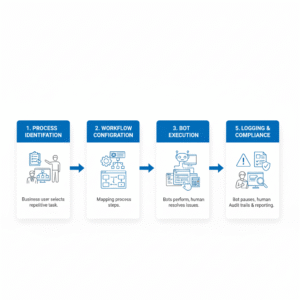
After setup, software bots execute these steps automatically. They can open applications, enter data, perform calculations and complete workflows much faster than humans. If a bot encounters an exception such as missing information or an unexpected system response—it can pause the process or notify a human employee. All bot activities are logged, making RPA particularly valuable for compliance and audit requirements in regulated US industries.
RPA vs Artificial Intelligence: Key Differences
Robotic process automation is often confused with artificial intelligence, but the two technologies serve different purposes. RPA focuses on executing predefined rules, while AI is designed to analyze data, learn patterns and make decisions. Many organizations combine both to build intelligent automation.
RPA vs AI Comparison Table
| Feature | Robotic Process Automation (RPA) | Artificial Intelligence (AI) |
| Primary function | Executes rule-based tasks | Learns and makes decisions |
| Data type | Structured data | Structured and unstructured data |
| Decision-making | No | Yes |
| Typical use | Data entry, workflow automation | Fraud detection, document understanding |
| Learning capability | None | Improves over time |
Common RPA Use Cases in the USA
Robotic process automation is widely used in industries that handle large volumes of repetitive tasks. In the insurance sector, RPA supports claims intake, policy servicing, renewals and compliance reporting. These workflows follow strict rules and involve structured data, making them ideal for automation.
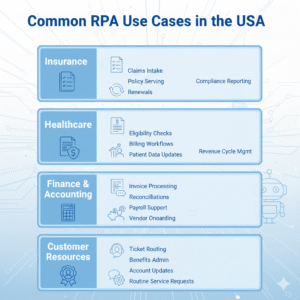
Healthcare organizations use RPA for insurance eligibility checks, billing operations, patient data updates and revenue cycle management. Financial and accounting teams rely on RPA to automate invoice processing, reconciliations, payroll support and vendor onboarding. Human resources departments use RPA to streamline employee onboarding, benefits administration and access management, while customer service teams use it to route tickets, update accounts and handle routine requests efficiently.
Benefits of Robotic Process Automation
While RPA offers many advantages, its value becomes clear when applied to the right processes. Businesses in the USA typically experience the following benefits:
- Faster processing times for repetitive workflows
- Reduced human errors and rework
- Lower operational costs without increasing headcount
- Improved compliance through detailed audit logs
- Increased employee productivity and job satisfaction
These benefits make robotic process automation a practical starting point for digital transformation initiatives.
Cost of Robotic Process Automation in the USA
The cost of implementing robotic process automation in the United States varies based on the platform, scale and complexity of the automation. Pricing models typically fall into three categories.
Typical RPA Cost Breakdown (USA)
| Cost Component | Estimated Range |
| RPA software license | $5,000 – $15,000 per bot per year |
| Implementation & setup | $5,000 – $50,000 (one-time, varies by complexity) |
| Maintenance & support | 15–25% of license cost annually |
| Training & governance | Varies by organization size |
Many organizations begin with a pilot automation to measure return on investment before expanding across departments. This phased approach reduces risk and ensures long-term success.
When Robotic Process Automation Is the Right Choice?
RPA delivers the strongest results when applied to stable, repetitive and rule-based processes. Tasks that involve structured data and occur frequently are ideal candidates. However, processes that require constant judgment, creativity, or frequent changes may not be suitable for RPA alone.
In such cases, combining RPA with AI or redesigning workflows can create better outcomes. Understanding process suitability before implementation is critical to avoiding automation failures.
How to Implement Robotic Process Automation Successfully?
Successful RPA initiatives start with clear process selection and documentation. Businesses should ensure data quality, define exception handling and establish governance controls before deployment. Starting with a small pilot allows teams to test automation performance, validate results and refine their approach.
Organizations that view RPA as a long-term operational capability rather than a quick fix are more likely to achieve scalable and sustainable automation outcomes.
Conclusion
Robotic process automation can create real efficiency when it’s applied to the right processes and set up correctly. But like any automation initiative, results depend on strategy, not just tools. Choosing the wrong workflows or rushing implementation can limit the value RPA delivers.
If you need expert guidance to understand where automation fits best in your operations, working with the right partner can make the process much simpler. The team at AmityFin helps businesses identify practical automation opportunities and implement RPA solutions that actually align with their goals.
If you’d like to talk through your use case or explore how automation could work for your business, visit amityfin.com or call +1 (888) 914-8699 to speak with an expert.
Recent posts
-

Digital Transformation in Insurance: How Technology is Reshaping the Future of the Industry
05 Feb, 2026 -

AI Auto Insurance: How Artificial Intelligence is Revolutionizing Car Insurance in the USA
05 Feb, 2026 -

Insurance Automation System: How Automation Is Transforming the Insurance Industry?
22 Jan, 2026