Automated Insurance Claims: How Automation Is Transforming the Claims Process in Insurance
Insurance claims play a major role in customer trust. When claims take too long, are confusing or contain errors, customers lose confidence and insurers face higher operating costs. As claim volumes increase and people expect faster, digital-first experiences, traditional claims processes can no longer keep pace. This is why automated insurance claims processing is no longer optional, it is a practical solution insurers need today.
Automated claims systems replace fragmented, manual workflows with intelligent, connected processes that reduce delays, improve accuracy and create a smoother experience for both insurers and policyholders. Claims automation refers to the use of digital systems, artificial intelligence and workflow automation to manage insurance claims from first notice of loss through settlement with minimal manual intervention.
What Are Automated Insurance Claims and How Does Claims Automation Work?
Automated insurance claims processing refers to the use of digital technologies to manage insurance claims activities with minimal manual intervention. Instead of relying on paperwork, emails, spreadsheets and repeated human data entry, automation handles claim intake, verification, assessment and resolution through structured workflows.
This approach does not remove human oversight. Instead, it allows claims professionals to focus on decision-making, exceptions and customer communication while routine tasks are handled by automated systems.
How Automated Insurance Claims Processing Works
Automated claims processing follows a connected workflow that begins the moment a claim is reported. Data flows through integrated systems rather than being passed manually between departments. Rules engines, artificial intelligence and validation checks guide each step, ensuring consistency and compliance.
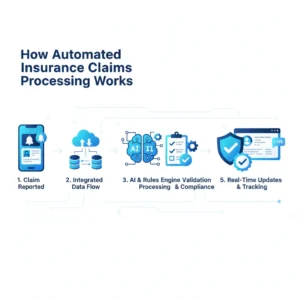
Automation also enables real-time updates within automated claims workflows, ensuring policyholders are informed instantly and claims teams maintain full visibility into claim status without manual tracking.
Moving Beyond Outdated Manual Processes
Manual insurance claims handling relies heavily on repetitive tasks such as form reviews, document sorting, data re-entry and follow-up emails. These processes are time-consuming and prone to human error, especially during high-volume periods.
Outdated systems also limit scalability. As claim demand increases, insurers are forced to add staff rather than improve efficiency. Automation removes these bottlenecks by creating standardized, repeatable workflows that perform consistently regardless of volume.
Manual vs Automated Insurance Claims: A Clear Comparison
The comparison below highlights how automated insurance claims outperform manual claims processing across speed, accuracy, cost and customer experience.
Comparison Table: Manual vs Automated Claims Processing
| Aspect | Manual Claims Processing | Automated Claims Processing |
| Claim Intake | Paper forms, emails, phone calls | Digital FNOL via apps, portals, AI assistants |
| Processing Speed | Often takes weeks | Up to 60% faster resolution |
| Data Entry | Heavy manual input | Automated data capture and validation |
| Error Rate | High due to re-entry | Up to 30% fewer errors |
| Fraud Detection | Reactive, manual reviews | AI-based real-time risk analysis |
| Customer Updates | Limited and delayed | Instant status notifications |
| Operational Cost | High staffing dependency | 25–40% cost reduction |
| Scalability | Requires more staff | Scales without linear hiring |
| Customer Satisfaction | Inconsistent experience | 20–30% higher satisfaction scores |
A Practical Guide to Automated Insurance Claims and Workflow Automation
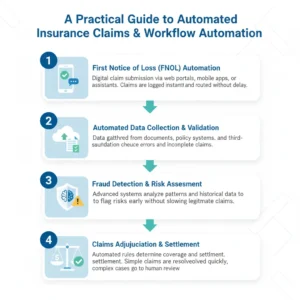
First Notice of Loss (FNOL) Automation
Automation begins with digital claim submission through web portals, mobile apps or virtual assistants. Claims are logged instantly, validated for completeness and routed without delay. This eliminates slow intake processes and ensures no information is lost at the first stage.
Automated Data Collection and Validation
Claims automation platforms gather information from multiple sources such as uploaded documents, photos, policy databases and third-party systems. Built-in validation checks reduce inconsistencies and prevent incomplete claims from moving forward.
Fraud Detection and Risk Assessment
Advanced systems analyze behavioral patterns, historical data and claim attributes to identify anomalies. Potential risks are flagged early, allowing claims teams to focus attention where it matters most without slowing down legitimate claims.
Claims Adjudication and Settlement
Automation applies predefined rules to determine coverage eligibility and settlement values. Straightforward claims can move directly to resolution, while complex cases are escalated for human review. This balance speeds up payouts without sacrificing accuracy.
Benefits of Automated Insurance Claims for Insurers
Automated insurance claims improve processing speed by eliminating unnecessary delays caused by manual reviews and handoffs. Operational costs decrease as repetitive tasks no longer require human intervention. Accuracy improves because standardized workflows reduce inconsistencies and missing data.
Customer satisfaction increases as policyholders receive faster responses, clearer communication and quicker resolutions. Internally, claims professionals experience reduced workload pressure and greater focus on meaningful tasks rather than administrative work.
Who Gains the Most from Claims Automation?
Insurance carriers benefit from lower operational expenses and improved scalability. Claims adjusters gain efficiency and clarity, allowing them to handle more cases with less stress. Agents and brokers experience fewer service disruptions and faster claim updates. Policyholders receive timely resolutions, transparent communication and a smoother overall experience.
Common Claims Processing Challenges and How Automation Solves Them
Large volumes of data entry often slow insurance claims teams and introduce errors. Automation captures and processes information automatically, reducing dependency on manual input.
Repetitive administrative tasks drain productivity. Workflow automation removes redundancy by executing routine actions consistently.
Paper-based documentation delays processing and increases storage risks. Digital records centralize information and improve accessibility.
Slow resolution times increase claim costs and customer frustration. Automation shortens cycle times without sacrificing quality.
Labor shortages strain claims departments. Automated systems support existing teams, allowing insurers to manage higher workloads without constant staffing increases.
Limitations and Considerations in Claims Automation
Legacy systems can complicate automation efforts due to limited integration capabilities. Regulatory compliance and data privacy must be carefully managed to ensure automated decisions meet legal standards.
Initial investment and training requirements should be planned strategically. Successful automation depends on clear objectives, phased implementation and employee adoption rather than rapid, unstructured deployment.
Technologies Driving Automated Insurance Claims
Claims automation relies on a combination of artificial intelligence, machine learning, optical character recognition and robotic process automation. APIs enable seamless communication between systems, while analytics tools provide real-time insight into claim performance and trends.
Core Features of an Effective Claims Automation System
A robust automation platform includes digital FNOL intake, intelligent workflows, fraud monitoring, audit logs, real-time dashboards and compliance tracking. These features ensure transparency, control and scalability across the claims lifecycle.
Automation’s Impact on Customer Experience
Today’s policyholders expect digital-first interactions. More than 80% of customers prefer online claim submission with real-time updates. Automated workflows meet these expectations by providing instant confirmations and transparent status tracking.
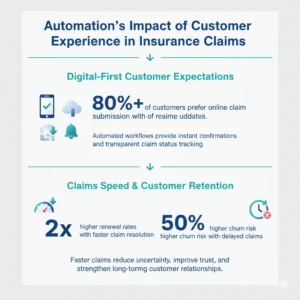
Claims speed within automated claims processes directly affects customer retention. Customers are twice as likely to renew policies when claims are resolved quickly, while delayed claims increase churn risk by nearly 50%. Automation helps insurers protect long-term customer relationships by reducing uncertainty and frustration.
The Future of Automated Insurance Claims
Claims automation is evolving toward predictive handling, self-service claims journeys and straight-through processing. Insurers are increasingly investing in systems that reduce friction, improve accuracy and create personalized experiences.
Claims automation is no longer about efficiency alone, they are becoming a competitive differentiator in customer trust and retention.
Why This Matters for Modern Insurance Operations?
Automated insurance claims processing is no longer just an efficiency upgrade, it is a strategic requirement. Faster resolutions, lower costs, improved fraud control and better customer experiences all contribute to stronger business performance.
Insurers using claims automation report:
- 20–30% higher customer satisfaction
- 15–25% improvement in policy renewals
- 35% fewer customer complaints
Conclusion: Why Claims Automation Matters Now?
Automated insurance claims processing enables insurers to respond faster, reduce operational friction and strengthen customer trust, operate smarter and meet modern customer expectations across the insurance lifecycle. As claim volumes increase and complexity grows, automation provides the foundation for sustainable, scalable claims operations.
How AmityFin Supports Automated Insurance Claims
AmityFin supports insurance agencies and carriers by enabling smarter claims workflows through automation, AI-driven processes and intelligent support systems. If you’re looking to reduce claim delays, improve operational efficiency and deliver a better claims experience, now is the time to modernize.
Ready to streamline your claims process?
Connect with AmityFin to explore how automation can transform your insurance operations.
Frequently Asked Questions (FAQs)
1. What are automated insurance claims?
Automated insurance claims use digital systems, artificial intelligence, and workflow automation to manage the claims process with minimal manual effort, while still allowing human oversight for complex cases.
2. How do automated insurance claims improve processing speed?
Automation removes manual tasks like paperwork and data entry, enabling faster claim intake, validation, and decision-making through digital workflows and rule-based processing.
3. Are automated insurance claims secure and compliant?
Yes. Modern claims automation systems include data encryption, access controls, audit trails, and compliance tools to meet regulatory and security requirements.
4. Can automated insurance claims replace human claims adjusters?
No. Automation supports claims adjusters by handling routine tasks, allowing professionals to focus on complex claims and customer interactions.
5. When should insurers implement claims automation?
Insurers should consider automation when claim volumes increase, processing times slow, costs rise, or customer satisfaction declines.
Recent posts
-

Digital Transformation in Insurance: How Technology is Reshaping the Future of the Industry
05 Feb, 2026 -

AI Auto Insurance: How Artificial Intelligence is Revolutionizing Car Insurance in the USA
05 Feb, 2026 -

Insurance Automation System: How Automation Is Transforming the Insurance Industry?
22 Jan, 2026