Insurance Automation System: How Automation Is Transforming the Insurance Industry?
The insurance industry is experiencing a major digital shift and one of the biggest drivers of this change is the rise of insurance automation systems. For decades, insurers relied heavily on manual work paper forms, slow internal communication, lengthy claim cycles and high operational overhead. Today’s customers expect faster service, clearer communication and more transparency and traditional processes simply cannot keep up.
Automation solves this problem by bringing speed, accuracy and intelligence into everyday insurance workflows.
Introduction to Insurance Automation Systems

An insurance automation system is a digital solution that streamlines tasks across underwriting, claims, policy servicing, billing and customer support. Instead of manual data entry, internal follow-ups and repetitive processing, automation handles these activities instantly and accurately. As insurers face rising customer expectations and increasing competition, automation has shifted from a convenience to a necessity.
Evolution of Automation in Insurance
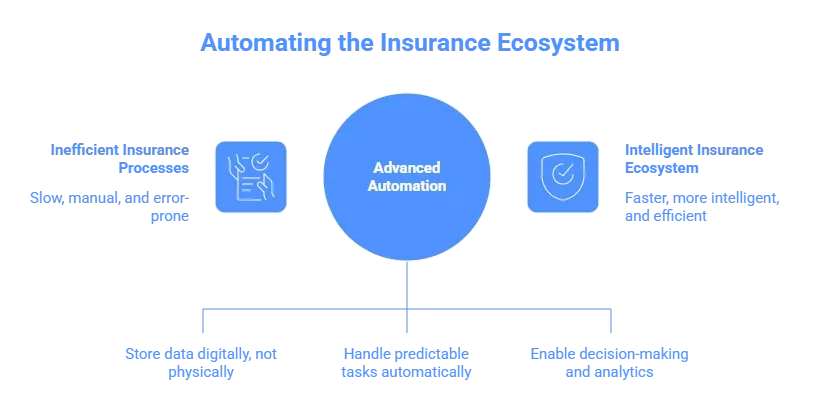
Insurance has moved through several phases of modernization.
First came basic digitalization using software to store data instead of physical files. Then rule-based automation was introduced to handle predictable tasks. Today, advanced automation powered by AI, machine learning and RPA has taken over, enabling decision-making, analytics and straight-through processing. This evolution sets the foundation for a faster and more intelligent insurance ecosystem.
What an Insurance Automation System Includes?

A modern automation system touches almost every part of insurance. It simplifies claims processing, speeds up underwriting, manages policies efficiently, automates fraud detection and enhances customer support. It also improves compliance by keeping records organized and helping insurers meet regulatory requirements. The result is a smoother, more reliable experience for both customers and internal teams.
Core Technologies Behind Insurance Automation
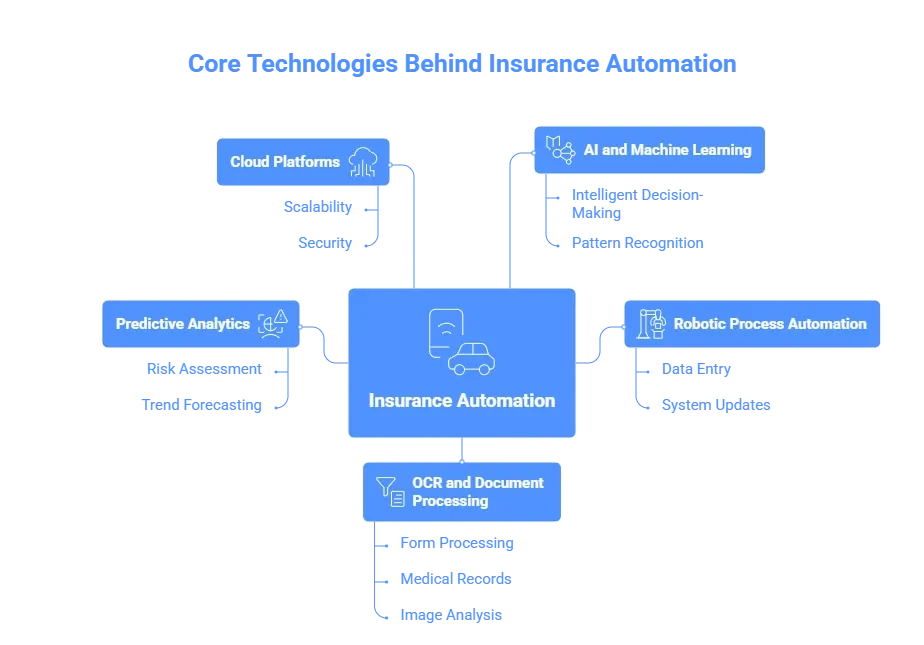
Behind every automation system are powerful technologies working together. AI and machine learning enable intelligent decision-making, while robotic process automation handles routine data entry and system updates. OCR and document processing extract information from forms, medical records, or images. Predictive analytics helps insurers anticipate risks and trends. And cloud platforms make it all scalable and secure. These components create a strong foundation for truly automated operations.
How an Insurance Automation System Works?
Automation begins at the data intake stage, where documents, forms, or digital entries are captured and analyzed. The system checks the information, verifies details and routes tasks to the right teams or completes them automatically. Throughout the process, customers receive updates, agents get real-time insights and managers can track performance easily. Everything moves faster and with fewer errors, leading to a more efficient end-to-end workflow.
Key Benefits of an Insurance Automation System
The impact of automation is immediate. Processing times drop significantly as repetitive steps are completed instantly. Accuracy improves because systems eliminate common human errors. For insurers, the reduction in manual work leads to lower operational costs. For customers, it means faster responses and clearer communication. Automation also boosts compliance, since every action is recorded and auditable.
Automation in Claims Management
Claims are one of the biggest pain points for both insurers and policyholders. Automation simplifies this entire journey. FNOL can be submitted through guided digital tools, information is automatically extracted from documents and AI can identify fraud patterns early. For simple cases, straight-through processing allows claims to be approved instantly, reducing delays and improving satisfaction. Complex claims are routed to adjusters with complete, organized files, helping them work more efficiently.
Automation in Underwriting & Policy Management
Underwriting becomes faster and more accurate with automation. Risk assessments use data from multiple sources instantly, quotes are generated automatically and policy issuance takes minutes instead of days. Renewals, endorsements and document updates happen smoothly without manual intervention. This reduces administrative burden and gives customers a seamless policy experience.
Challenges in Implementing an Insurance Automation System
Despite its advantages, automation comes with challenges. Legacy systems often make integration difficult and inconsistent data can slow down automation efforts. Insurers must also ensure data privacy and follow regulations carefully since sensitive information is involved. Employee adaptation is another factor teams need proper training to work effectively with automated systems. When these challenges are addressed, automation reaches its full potential.
The Future of Insurance Automation Systems
The future of automation is moving toward intelligent and autonomous operations. Agentic AI will manage complete workflows with minimal human involvement. Claims may soon become fully automated for simple cases, from FNOL to payment. Predictive underwriting will tailor policies to individual customers and blockchain will enable instant, secure payouts. As automation systems connect with IoT devices, telematics and real-time data sources, insurance will become faster, smarter and more personalized than ever.
Conclusion
Insurance automation systems are transforming the industry by making processes faster, more accurate and more customer-friendly. They reduce manual work, improve efficiency and deliver the kind of modern experience policyholders now expect. Insurers that invest in automation gain a competitive edge those who delay risk falling behind.
Automation isn’t the future anymore, it’s the new standard of insurance operations.
Want to modernize your insurance workflow with smarter automation? Connect with us at AmityFin or speak with our team at +1 (888) 914-8699.
FAQ 1: What is an insurance automation system?
An insurance automation system is a digital platform that streamlines tasks such as underwriting, claims processing, policy management, and customer support. It reduces manual work, speeds up decisions, and improves overall accuracy.
FAQ 2: How does automation improve claims processing?
Automation speeds up the claims process by capturing data instantly, validating documents, detecting fraud patterns, and enabling straight-through processing for simple claims. This reduces delays and improves customer satisfaction.
FAQ 3: What technologies are used in insurance automation?
Insurance automation relies on AI, machine learning, robotic process automation (RPA), OCR, predictive analytics, and cloud-based systems. Together, these technologies create a faster and more intelligent workflow.
FAQ 4: Can automation reduce operational costs for insurers?
Yes. Automation cuts manual workload, eliminates repetitive tasks, reduces staffing pressure, and minimizes errors resulting in significantly lower operational costs for insurers.
FAQ 5: Is it difficult to integrate an automation system with existing insurance platforms?
Integration can be challenging for insurers with older legacy systems, but modern automation tools are designed to work alongside existing platforms. With the right implementation strategy, integration becomes smooth and scalable.
Recent posts
-

Digital Transformation in Insurance: How Technology is Reshaping the Future of the Industry
05 Feb, 2026 -
AI Auto Insurance: How Artificial Intelligence is Revolutionizing Car Insurance in the USA
05 Feb, 2026 -

Insurance Automation System: How Automation Is Transforming the Insurance Industry?
22 Jan, 2026