Intelligent Automation in Insurance: A Practical Guide for Modern Insurers
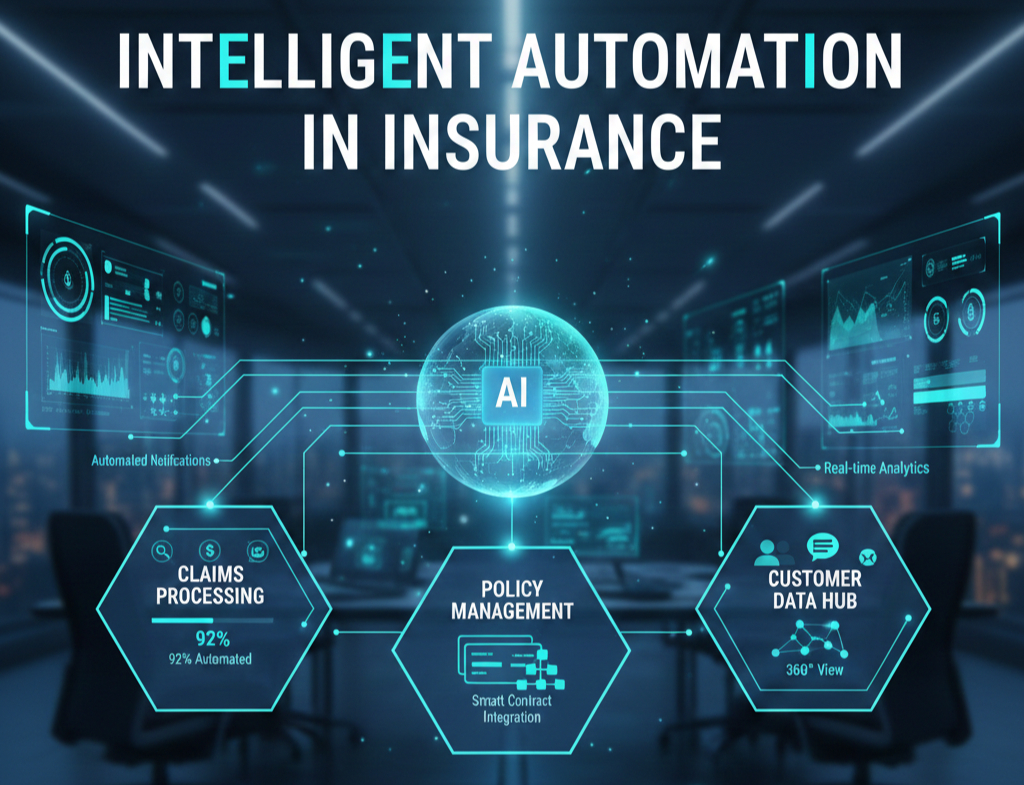
The insurance industry has always operated at the intersection of risk, data and trust. Today, that intersection is being reshaped by intelligent automation in insurance a strategic evolution that goes far beyond traditional process automation. Insurers are no longer asking whether to automate, but how intelligently they can do it.
This article explores intelligent automation from a real-world insurance perspective what it truly means, where it delivers the most value and how insurers can adopt it in a way that is sustainable, compliant and growth-focused.
Understanding Intelligent Automation in Insurance
Intelligent automation in insurance combines robotic process automation (RPA) with artificial intelligence (AI) technologies such as machine learning, natural language processing and advanced analytics. The result is automation that does not simply execute predefined rules, but can interpret data, learn from outcomes and support decision-making.
Intelligent automation in insurance refers to the use of AI-driven technologies such as RPA, machine learning and NLP to automate, optimize and continuously improve core insurance processes like underwriting, claims, compliance and customer service.
This shift marks a clear departure from legacy automation, which was limited to repetitive, rule-based tasks and struggled with exceptions or unstructured data.
Why Intelligent Automation in Insurance Is Becoming Essential?
Insurance operations are inherently complex. Policy lifecycles involve multiple handoffs, regulatory checks and data validations. Claims workflows must balance speed with accuracy and fraud prevention. Customer service teams are under pressure to deliver instant responses while maintaining personalization.
Intelligent automation addresses these pressures by creating connected, data-driven workflows that operate at scale. Instead of isolated tools, insurers gain an ecosystem where systems communicate, decisions are supported by data and processes adapt dynamically.
This is especially critical in an environment where digital-first customers expect faster service, regulators demand transparency and margins are increasingly sensitive to operational efficiency.
Core Insurance Processes Transformed by Intelligent Automation
Underwriting and Policy Issuance
Underwriting is one of the earliest beneficiaries of intelligent automation in insurance. AI-powered models analyze applicant data, historical loss trends, third-party data sources and behavioral indicators to support faster and more consistent risk evaluation.
Automation reduces manual data entry, flags missing or inconsistent information and ensures underwriting guidelines are applied uniformly. As a result, insurers can issue policies faster while improving pricing accuracy and reducing underwriting leakage.
Over time, machine learning models refine themselves, enabling insurers to respond more effectively to market changes and emerging risk patterns.
Claims Management and FNOL Automation
Claims processing is where customer trust is tested most directly. Intelligent automation plays a crucial role from First Notice of Loss (FNOL) to final settlement.
Automated FNOL solutions capture claim information across digital channels, extract data from documents and images and route claims based on complexity and severity. AI-driven fraud detection models identify unusual patterns early, allowing insurers to focus investigative resources where they matter most.
By reducing manual intervention in routine claims, insurers can accelerate settlements for legitimate customers while maintaining strong controls over loss exposure.
Customer Experience and Service Operations
Modern insurance customers value speed, clarity and accessibility. Intelligent automation enables insurers to deliver consistent service through AI chatbots, virtual assistants and automated communication workflows.
These systems handle common inquiries, policy updates, payment reminders and claim status requests around the clock. More complex cases are escalated seamlessly to human agents, supported by full interaction history and contextual data.
The result is a more responsive service model that improves customer satisfaction without increasing support costs.
Compliance, Governance and Risk Oversight
Regulatory compliance remains one of the most sensitive areas in insurance. Intelligent automation supports compliance by embedding controls directly into operational workflows.
Automated monitoring tools validate documentation, enforce approval hierarchies, maintain audit trails and generate real-time compliance reports. This reduces reliance on manual checks and lowers the risk of regulatory breaches, while improving transparency across the organization.
Business Value of Intelligent Automation in Insurance
When implemented strategically, intelligent automation delivers measurable business outcomes rather than isolated efficiency gains. Insurers typically see improvements in:
- Operational efficiency and cost control
- Accuracy and consistency in underwriting and claims
- Fraud detection and risk mitigation
- Speed-to-market for new insurance products
- Customer retention through improved service experiences
Equally important, automation enables teams to shift focus from administrative work to higher-value activities such as customer advisory, product innovation and strategic analysis.
Implementation Considerations for Long-Term Success
Despite its benefits, intelligent automation is not a plug-and-play solution. Insurers must address foundational elements such as data quality, legacy system integration and organizational readiness.
A successful approach typically starts with high-impact use cases claims intake, underwriting support or customer service before expanding automation across the value chain. Clear governance, performance metrics and ongoing model oversight are essential to ensure automation remains compliant and effective.
Working with experienced automation partners can significantly reduce implementation risk and accelerate value realization.
The Road Ahead for Intelligent Automation in Insurance
As technology matures, intelligent automation will evolve into end-to-end orchestration across insurance operations. Predictive analytics, real-time decisioning and personalized insurance offerings will become standard capabilities rather than differentiators.
Industry studies indicate that insurers using intelligent automation can reduce claims processing time by 20–30% while improving accuracy and fraud detection.
Insurers that invest today will be better positioned to adapt to regulatory changes, market volatility and rising customer expectations while those that delay risk falling behind more agile competitors.
Conclusion
Intelligent automation in insurance represents a strategic shift toward smarter, more resilient operations. It enables insurers to process information faster, make better decisions and deliver more consistent experiences across the policy lifecycle.
Many insurers struggle to implement intelligent automation without disrupting existing workflows. AmityFin helps insurance organizations design automation strategies aligned with regulatory and operational realities.
Talk to an automation specialist: +1 (888) 914-8699
Explore how intelligent automation can help your insurance business operate with greater efficiency, accuracy and confidence.
Frequently Asked Questions: Intelligent Automation in Insurance
What is intelligent automation in insurance?
It is using smart technologies like AI and robots to help insurance companies do tasks faster and more accurately, like handling claims, underwriting and customer service.
How is it different from regular automation?
Regular automation just follows fixed rules. Intelligent automation can learn, understand data and make decisions, helping with things like fraud detection and risk assessment.
Which insurance tasks benefit the most?
Tasks like claims processing, policy approval, fraud checking, customer support and compliance are the biggest winners from intelligent automation.
Is intelligent automation safe and compliant with rules?
Yes. When done right, it helps companies follow regulations by tracking actions, keeping audit trails and ensuring proper approvals.
What are the main benefits for insurance companies?
It saves time, reduces errors, detects fraud, speeds up processes and improves customer service.
Recent posts
-

Digital Transformation in Insurance: How Technology is Reshaping the Future of the Industry
05 Feb, 2026 -
AI Auto Insurance: How Artificial Intelligence is Revolutionizing Car Insurance in the USA
05 Feb, 2026 -
Insurance Automation System: How Automation Is Transforming the Insurance Industry?
22 Jan, 2026